Mohr's Circle Without the Confusion
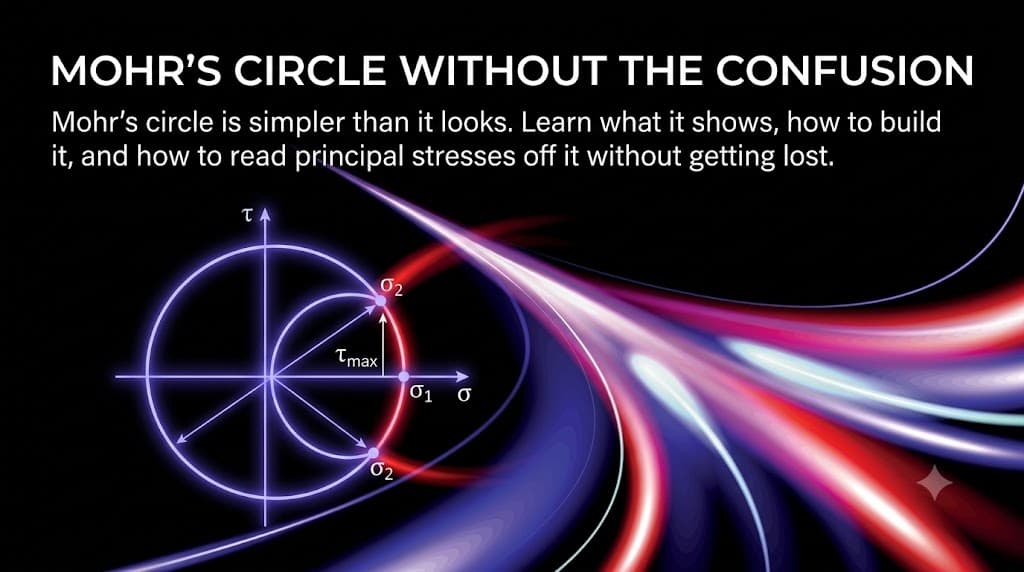
Mohr's circle is simpler than it looks. Learn what it shows, how to build it, and how to read principal stresses off it without getting lost.
On this page
Mohr's Circle Without the Confusion
A picture that turns messy stress into something you can read
What is Mohr's circle?
Mohr's circle is a simple graph that shows how the stress at a point changes as you rotate the plane you look at it on, and lets you read off the worst-case stresses directly.
The reason it exists is that stress at a point is not a single number. Cut through the same point at different angles and you find different combinations of normal stress and shear stress. Somewhere among all those angles are the largest stresses the material feels, and those are what cause failure. Mohr's circle finds them for you, with a drawing instead of heavy algebra.
Why it matters
A part rarely fails on the plane you happened to draw. It fails on whatever plane carries the highest stress, and that plane is usually tilted at some awkward angle you did not choose.
Mohr's circle finds that plane. It hands you the largest normal stresses, called the principal stresses, and the largest shear stress, without you having to test every possible angle by hand. Those peak values are what you compare against the material's limits, so this is a direct route to knowing whether a part survives.
Building it from first principles
Start with a tiny square of material at the point you care about.
Each face of that square carries a normal stress, pushing straight in or out, and a shear stress, sliding along it. Now imagine slowly rotating the square. As it turns, the normal and shear stresses on its faces change in a smooth, predictable way.
Mohr had the insight that if you plot normal stress across and shear stress up, every possible orientation of that square traces out a circle. That single circle contains every stress state at the point, for every angle, all at once.
Building the circle
The circle is defined by two things you can compute directly.
- The centre sits on the horizontal axis at the average of the two normal stresses.
- The radius comes from how different the normal stresses are and how much shear is present.
Once you have the circle, everything you need is on it:
- Principal stresses are where the circle crosses the horizontal axis. At those points the shear is zero, and the normal stress is at its largest and smallest.
- Maximum shear stress is simply the radius of the circle, found at its top and bottom.
So the whole method is: find the centre, find the radius, draw the circle, and read the answers off it.
💡 Rule of thumb: on Mohr's circle, angles double. Rotating the real element by an angle moves you around the circle by twice that angle. This is the single detail that trips most people up.
A quick worked example
Suppose a point has a normal stress of 80 in one direction, 20 in the other, and a shear stress of 30.
- Centre is the average of 80 and 20, which is 50.
- Radius combines the half-difference, 30, with the shear, 30, giving a radius of about 42.
- Principal stresses are the centre plus and minus the radius, so about 92 and 8.
- Maximum shear is the radius, about 42.
In four short steps you have the largest and smallest normal stresses and the peak shear, which is exactly what you check against the material.
Common beginner mistakes
- Forgetting that angles on the circle are double the real rotation angle
- Getting the sign of the shear stress backwards
- Reading principal stresses from the wrong points on the circle
- Trying to memorise the formulas without picturing the circle they come from
Interview questions
Mohr's circle appears because it shows whether you understand that stress depends on orientation. Here is what interviewers listen for.
"What does Mohr's circle show?" How normal and shear stress at a point vary with the orientation of the plane, and where the principal stresses and maximum shear occur.
"What are principal stresses?" The largest and smallest normal stresses at a point, found where the shear stress is zero. On the circle they are the two horizontal crossing points.
"Where is the maximum shear stress on the circle?" At the top and bottom. It equals the radius of the circle.
"Why do angles double on Mohr's circle?" It is a property of how the stress equations transform. A real rotation of an angle corresponds to moving twice that angle around the circle.
Quick reference
| Feature on the circle | What it gives you |
|---|---|
| Centre | Average of the normal stresses |
| Radius | Maximum shear stress |
| Horizontal crossings | Principal stresses, where shear is zero |
| Top and bottom | Planes of maximum shear |
Key takeaways
If you remember five things, make it these.
- Stress at a point depends on orientation, and Mohr's circle captures every orientation at once.
- The centre is the average normal stress, and the radius is the maximum shear.
- Principal stresses are where the circle crosses the axis, with zero shear.
- Maximum shear equals the radius, at the top and bottom.
- Angles double on the circle compared with the real rotation.
Practice on FixtureLabs
Mohr's circle clicks once you draw a few. On FixtureLabs, work through problems that ask you to build the circle and read principal stresses and maximum shear straight off it.
Written by
FixtureLabs Inc.
FixtureLabs Inc. writes about fixture design, GD&T and how modern teams pair classical mechanical engineering with AI.