Fatigue Failure 101: Why Parts Break Below Yield Strength
Parts fail under loads far below their strength when those loads repeat. Learn how fatigue works, why it is so dangerous, and how to design against it.
On this page
Fatigue Failure 101: Why Parts Break Below Yield Strength
How a part that survives one load fails after a million
What is fatigue?
Fatigue is failure caused by loads that repeat, at stresses well below what the material could survive if the load were applied only once.
This is the part that surprises people. A component can be perfectly safe under a single heavy load, then fail months later under a much lighter load that simply repeated millions of times. The metal did not get weaker. Tiny damage built up cycle by cycle until a crack grew large enough to break the part. Most real-world mechanical failures are fatigue failures, which is why it matters so much.
Why it matters
Almost nothing in engineering sees a single, steady load. Loads cycle. A shaft rotates, a wing flexes with every gust, a spring compresses and releases, a gear tooth is hit once per turn. Every one of those cycles is a chance for fatigue.
Design only against a single load and you will miss the failure mode that actually gets most parts. A design that is strong enough on paper can still crack in service if nobody thought about how many times the load repeats.
Building it from first principles
Fatigue is death by a thousand cuts.
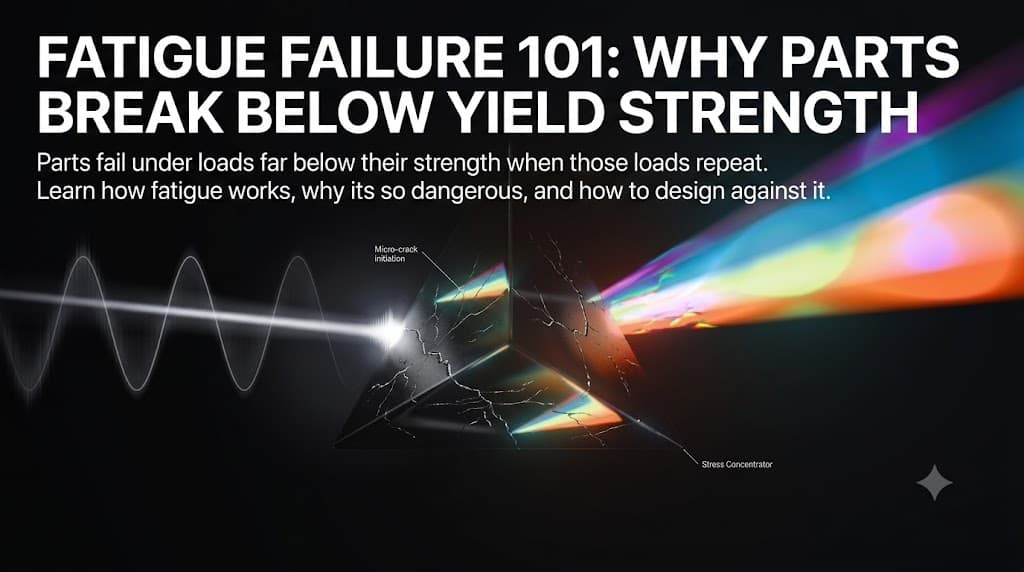
Each time the load rises and falls, it does a tiny amount of damage. The damage almost always starts at a stress riser, a spot where stress concentrates, such as a sharp corner, a hole, or even a scratch. A microscopic crack forms there, then grows a little with every cycle. For a long time you see nothing. Then the remaining material can no longer carry the load, and the part snaps suddenly, often with no warning at all.
That sudden, warning-free failure is what makes fatigue dangerous.
The S-N curve
Fatigue behaviour is captured in one graph.
The S-N curve plots stress against the number of cycles a material survives at that stress.
- Higher stress, fewer cycles. Push hard and the part fails soon.
- Lower stress, more cycles. Ease off and it lasts far longer.
- Endurance limit. Some materials, notably steels, have a stress below which they survive essentially forever. Stay under it and fatigue never becomes a problem. Aluminium has no such limit, so an aluminium part always has a finite life.
This is why steel and aluminium parts are designed differently for cyclic loads.
Stress risers start the crack
Because cracks almost always begin at a stress concentration, controlling those spots is the heart of fatigue design.
Sharp internal corners, holes, keyways, and rough machining marks all concentrate stress and hand fatigue a place to begin. The fixes are the same ones good design already encourages:
- Add generous fillets to internal corners so stress flows smoothly instead of piling up.
- Improve the surface finish, since scratches are crack starters.
- Keep working stresses low, ideally below the endurance limit for steels.
💡 Rule of thumb: fatigue cracks start where stress concentrates. A sharp corner is not just harder to machine, it is a fatigue crack waiting to happen.
A quick worked example
A rotating steel shaft carries a bending load. Every single rotation flips the stress from tension to compression, so at 3,000 rotations per minute it sees millions of cycles in an hour.
Checked against a single load, the shaft is fine. Checked against its S-N curve, the working stress must sit below the steel's endurance limit, or the shaft will crack after enough cycles no matter how strong it looked statically. Add a fillet where the shaft steps down in diameter, and you remove the stress riser that would otherwise start the crack.
Common beginner mistakes
- Designing only against a single load and ignoring how often it repeats
- Leaving sharp corners and rough finishes that start cracks
- Assuming a part safe under static load is safe under cyclic load
- Treating aluminium like steel and expecting an endurance limit it does not have
Interview questions
Fatigue comes up constantly because it is where theory meets real failure. Here is what interviewers listen for.
"What is fatigue failure?" Failure from repeated loading at stresses below the static strength. A crack starts at a stress riser and grows each cycle until sudden fracture.
"Why can a part fail below its yield strength?" Because cyclic loading grows a crack over many cycles. The static strength describes a single load, not repeated ones.
"What is an endurance limit, and which materials have one?" A stress below which a material survives effectively unlimited cycles. Steels have one, aluminium does not.
"How do you design against fatigue?" Keep stresses low, ideally below the endurance limit, and remove stress risers with fillets and good surface finish.
Quick reference
| Idea | What it means | Design response |
|---|---|---|
| Cyclic load | Load that repeats many times | Check cycles, not just peak load |
| Stress riser | Spot where stress concentrates | Add fillets, smooth finishes |
| S-N curve | Stress versus cycles to failure | Read allowable stress for a life |
| Endurance limit | Stress for unlimited life, steels only | Stay below it for infinite life |
Key takeaways
If you remember five things, make it these.
- Fatigue is failure from repeated loads below the static strength.
- Cracks start at stress risers like sharp corners, holes, and scratches.
- The S-N curve shows how stress trades against the number of cycles.
- Steels have an endurance limit, aluminium does not, so they are designed differently.
- Fillets and good surface finish are frontline fatigue defences.
Practice on FixtureLabs
Fatigue thinking becomes second nature with practice. On FixtureLabs, work through problems that ask you to spot stress risers, read an S-N curve, and design a part to survive its cycles.
Written by
FixtureLabs Inc.
FixtureLabs Inc. writes about fixture design, GD&T and how modern teams pair classical mechanical engineering with AI.