Tolerance Stack-Up Analysis: A Worked Example
Small tolerances add up until parts stop fitting. Walk through a stack-up step by step and learn how to check that an assembly will actually go together.
On this page
Tolerance Stack-Up Analysis: A Worked Example
Every part is in spec, so why does the assembly not fit?
What is a tolerance stack-up?
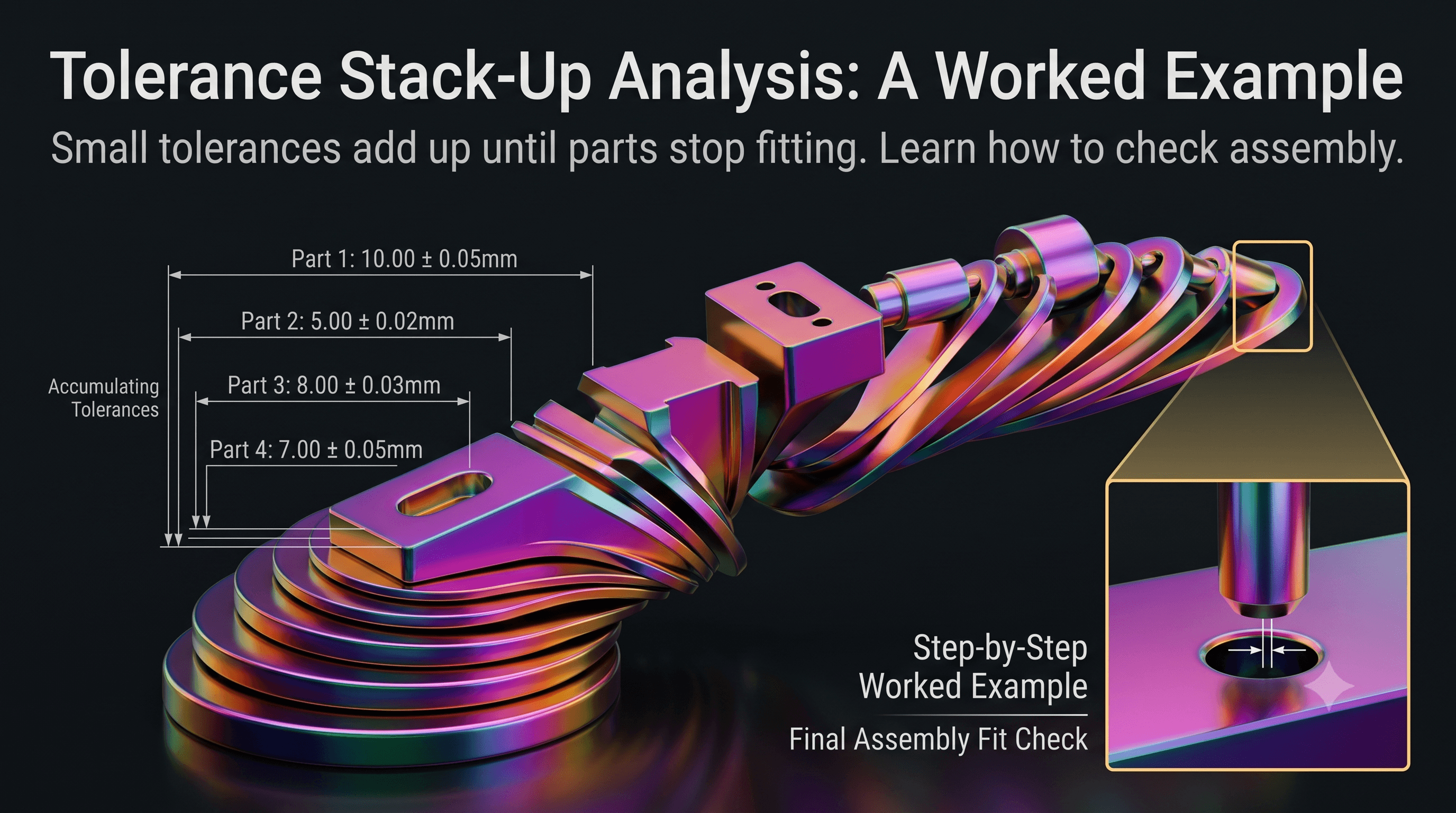
A tolerance stack-up is adding together the tolerances of the individual parts in an assembly to find the total possible variation in a gap or dimension you care about.
Here is the problem it solves. Every part in an assembly can be perfectly within its own tolerance, yet when you stack several of them together, their small allowed variations add up. The gap you needed can end up too big or too small even though nothing was made out of spec. A stack-up analysis predicts that total variation on paper, before you cut metal, so you find the problem in CAD instead of on the assembly line.
Why it matters
Assemblies fail to fit for a reason that feels unfair: every part passed inspection.
That happens because tolerances accumulate. A stack of five parts, each allowed to vary a little, can produce a final gap that swings far more than any single part. Without a stack-up you are trusting luck that the variations cancel out. With one, you know the worst the gap can be and can design so it always works.
The core idea
A stack-up follows a chain of dimensions to the gap you care about.
Imagine several blocks stacked in a slot, and you care about the gap left at the top.
- The nominal gap is the slot size minus the sum of the block heights.
- The variation in that gap comes from every tolerance in the chain added together.
So you list every dimension between the two ends of the gap, add the nominal sizes to find the average gap, and combine the tolerances to find how much that gap can swing. The result tells you the smallest and largest the gap can ever be.
Worst case versus statistical
There are two ways to combine the tolerances, and they give different answers.
- Worst case. You add every tolerance directly, assuming every part is at its worst extreme at the same time. This guarantees the assembly always fits, but it is pessimistic, because all parts being at their extreme together is very unlikely. It often forces tighter, more expensive tolerances than you really need.
- Statistical. You combine the tolerances by adding them in quadrature, which reflects that parts vary randomly and rarely all land at their extreme together. It gives a realistic, smaller total variation, which lets you use looser individual tolerances, though a few assemblies at the very edge may need attention.
Worst case is safe and simple. Statistical is realistic and cheaper. Which you use depends on how critical the fit is and how many you make.
A worked example
Three blocks sit in a slot. The slot is 100 with a tolerance of plus or minus 0.1. Each block is 30 with a tolerance of plus or minus 0.05.
- Nominal gap: 100 minus three times 30, which is 100 minus 90, a 10 gap.
- Worst-case variation: add the tolerances, 0.1 for the slot plus three times 0.05 for the blocks, which is 0.1 plus 0.15, so plus or minus 0.25.
- So the gap ranges from 9.75 to 10.25 in the worst case.
If the design needs the gap to stay above 9.8, worst case says it could reach 9.75 and fail, so you would either tighten a tolerance or accept the small statistical risk instead.
Tightening a stack-up
When the total variation is too big, you have a few levers.
- Shorten the chain. Fewer parts between the two ends means fewer tolerances to add. Combining parts is the biggest win.
- Tighten the biggest contributor. One or two dimensions usually dominate. Tighten those, not everything.
- Switch to a statistical analysis if the fit allows it, which relaxes the individual tolerances.
💡 Rule of thumb: the fewer parts in the chain, the smaller the stack-up. Reducing part count helps tolerances as much as it helps cost.
Common beginner mistakes
- Assuming that if every part is in spec, the assembly must fit
- Adding tolerances the wrong way, mixing worst case and statistical
- Missing a dimension in the chain
- Tightening every tolerance instead of the one that dominates
- Forgetting that a longer chain of parts always stacks up more
Interview questions
Stack-up questions test whether someone thinks about assemblies, not just single parts. Here is what interviewers listen for.
"What is a tolerance stack-up?" Adding the tolerances of the parts in an assembly to find the total variation in a gap or dimension, even when every part is in spec.
"What is the difference between worst-case and statistical analysis?" Worst case adds tolerances directly and guarantees fit but is pessimistic. Statistical combines them in quadrature for a realistic, smaller total that allows looser individual tolerances.
"An assembly does not fit even though every part passed inspection. What happened?" The tolerances stacked up. Each part was in spec, but their variations added to more than the assembly could absorb.
"How would you reduce a stack-up that is too large?" Shorten the chain by combining parts, tighten the dominant contributor, or use a statistical analysis if the fit allows.
Quick reference
| Method | How tolerances combine | Result |
|---|---|---|
| Worst case | Added directly | Always fits, but pessimistic and costly |
| Statistical | Combined in quadrature | Realistic, smaller, allows looser tolerances |
| Shorten chain | Fewer parts | The strongest way to cut variation |
Key takeaways
If you remember five things, make it these.
- Parts in spec can still fail to assemble because tolerances add up.
- A stack-up follows a chain of dimensions to the gap you care about.
- Worst case guarantees fit but is pessimistic; statistical is realistic and cheaper.
- One or two dimensions usually dominate, so tighten those.
- Fewer parts in the chain is the strongest way to shrink a stack-up.
Practice on FixtureLabs
Stack-ups make sense once you run the numbers. On FixtureLabs, work through assemblies that ask you to build the chain, add the tolerances, and decide whether the gap always fits.
Written by
FixtureLabs Inc.
FixtureLabs Inc. writes about fixture design, GD&T and how modern teams pair classical mechanical engineering with AI.