Bernoulli's Equation Explained, and Where It Breaks Down
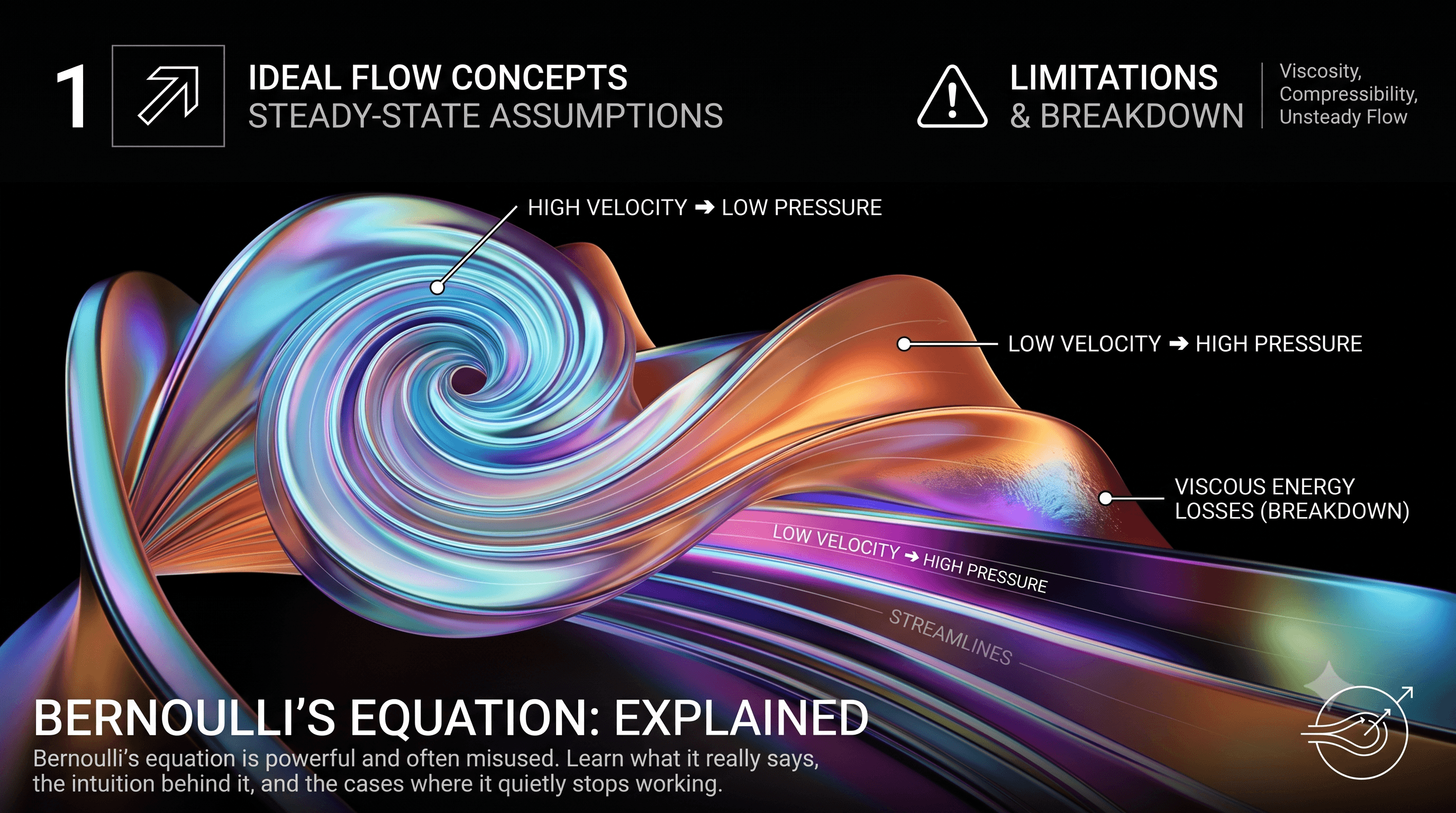
Bernoulli's equation is powerful and often misused. Learn what it really says, the intuition behind it, and the cases where it quietly stops working.
On this page
Bernoulli's Equation Explained, and Where It Breaks Down
Why fast-moving fluid has low pressure, and when that rule fails
What is Bernoulli's equation?
Bernoulli's equation is a rule for flowing fluid that links its pressure, its speed, and its height. Its headline result is simple: where a fluid speeds up, its pressure drops, and where it slows down, its pressure rises.
Underneath, it is just conservation of energy applied to a fluid moving along a streamline. The fluid carries energy in three forms, and as it flows, those forms trade back and forth while the total stays fixed. That single idea explains a surprising amount of the world, from how a spray bottle works to why a shower curtain sucks inward. It is also one of the most misused equations in engineering, which is why knowing its limits matters as much as knowing the equation.
Why it matters
Bernoulli's equation is the quick mental tool engineers reach for whenever a fluid changes speed.
It explains how a carburettor draws fuel, how a venturi meter measures flow, how a pitot tube reads an aircraft's speed, and part of how a wing makes lift. When you can look at a pipe narrowing and instantly know the pressure there drops, you can reason about fluid systems without heavy computation. But the same simplicity that makes it useful also makes it easy to apply where it does not hold.
Building it from first principles
Follow a parcel of fluid along its path.
The energy in that parcel comes in three parts:
- Pressure energy, from the pressure pushing it along.
- Kinetic energy, from its speed.
- Potential energy, from its height.
Bernoulli's insight is that along a streamline, with no friction and nothing adding or removing energy, the sum of these three stays constant. So if the fluid speeds up, its kinetic part rises, and to keep the total fixed, its pressure part must fall. That is the whole reason fast flow means low pressure.
You can see it directly in a pipe that narrows. The same amount of fluid must pass through the smaller section, so it speeds up, and its pressure drops in the narrow part.
Where you see it
The same principle shows up all over engineering.
- Venturi meter. A deliberate narrowing in a pipe. The pressure drop across it reveals the flow speed.
- Pitot tube. Points into the flow and measures the pressure rise as the fluid is brought to a stop, which gives the speed. This is how aircraft measure airspeed.
- Wings and spray. Faster flow over the top of a wing has lower pressure, contributing to lift, and the low pressure of fast air is what pulls liquid up into a spray.
Where it breaks down
This is the part most people skip, and it is where mistakes happen. Bernoulli's equation assumes an ideal fluid, and real fluids are not ideal.
It quietly assumes:
- No friction. Real fluids have viscosity, which drains energy as the fluid rubs against walls and itself. Over long pipes or thick fluids, this loss is large and Bernoulli overpredicts pressure.
- Steady, smooth flow. Turbulence and rapidly changing flow break it.
- Incompressible flow. At high speeds, near and above the speed of sound, the fluid's density changes and the simple form no longer holds.
- Nothing adds or removes energy. You cannot apply it straight across a pump or a fan, which inject energy.
So the rule of thumb is to trust Bernoulli for short, fast, smooth changes in speed, and to be suspicious of it over long distances, in thick or turbulent fluids, at very high speed, or across any machine that adds energy.
💡 Rule of thumb: Bernoulli is an energy budget with no losses. The moment friction, turbulence, or a pump enters the picture, that budget no longer balances, and you need more than Bernoulli.
A quick worked example
Water flows through a pipe that narrows to half its area.
- Speed. To pass the same flow through half the area, the water must move twice as fast in the narrow section.
- Pressure. Since it sped up, its pressure drops in the narrow part, by an amount Bernoulli predicts from the change in speed.
That predicted pressure drop is accurate for a short, smooth venturi. Try to apply the same equation across a hundred metres of rough pipe and it will be badly wrong, because friction has drained energy the equation assumes is conserved.
Common beginner mistakes
- Applying Bernoulli across a pump or fan, which adds energy
- Using it over long pipes where friction losses dominate
- Ignoring that high-speed flow is compressible and breaks the simple form
- Treating the wing lift explanation as the whole story rather than a simplification
- Forgetting it only holds along a streamline
Interview questions
Bernoulli questions reward people who know both the equation and its limits. Here is what interviewers listen for.
"What does Bernoulli's equation tell you?" That along a streamline with no losses, pressure, speed, and height trade off at constant total energy, so faster flow has lower pressure.
"Why does pressure drop where a pipe narrows?" The fluid must speed up to pass through the smaller area, raising its kinetic energy, so its pressure energy falls to keep the total constant.
"When can you not use Bernoulli's equation?" When there is significant friction, turbulence, or compressibility, or across any device that adds or removes energy, like a pump.
"How does a pitot tube measure speed?" It brings the flow to a stop and measures the resulting pressure rise, which relates directly to the fluid's speed through Bernoulli.
Quick reference
| Term | Represents | Note |
|---|---|---|
| Pressure energy | Pressure pushing the fluid | Falls as speed rises |
| Kinetic energy | The fluid's speed | Rises in narrow sections |
| Potential energy | The fluid's height | Matters with elevation change |
| Assumptions | No friction, incompressible, no added energy | Where it breaks down |
Key takeaways
If you remember five things, make it these.
- Bernoulli's equation is energy conservation for a fluid along a streamline.
- Faster flow means lower pressure, and slower flow means higher pressure.
- It explains venturis, pitot tubes, sprays, and part of lift.
- It assumes no friction, no compressibility, and no added energy.
- It breaks down over long pipes, in turbulent or fast flow, and across pumps.
Practice on FixtureLabs
Bernoulli clicks when you apply it and test its limits. On FixtureLabs, work through flow problems that ask you to find pressure and speed, and to judge when the equation still holds.
Written by
FixtureLabs Inc.
FixtureLabs Inc. writes about fixture design, GD&T and how modern teams pair classical mechanical engineering with AI.